The New Rules: Delivery Service Providers (DSPs) and Their Contracts
Part 4: How to Succeed: Creating a Sustainable Partnership

Three articles into this DSP series, you know the history. As DSPs have evolved and become a vital part of restaurant revenue, restaurant leaders are starting to focus on the complexity of DSP contracts and the importance of their partnerships.
Collaboration not Competition
The goal of a DSP negotiation is to approach them as a collaborative partner. It is important to enter the process with clarity about what you want, a structured approach to getting it, and the expertise to evaluate what you're being offered. That combination is what produces a sustainable, healthy partnership.
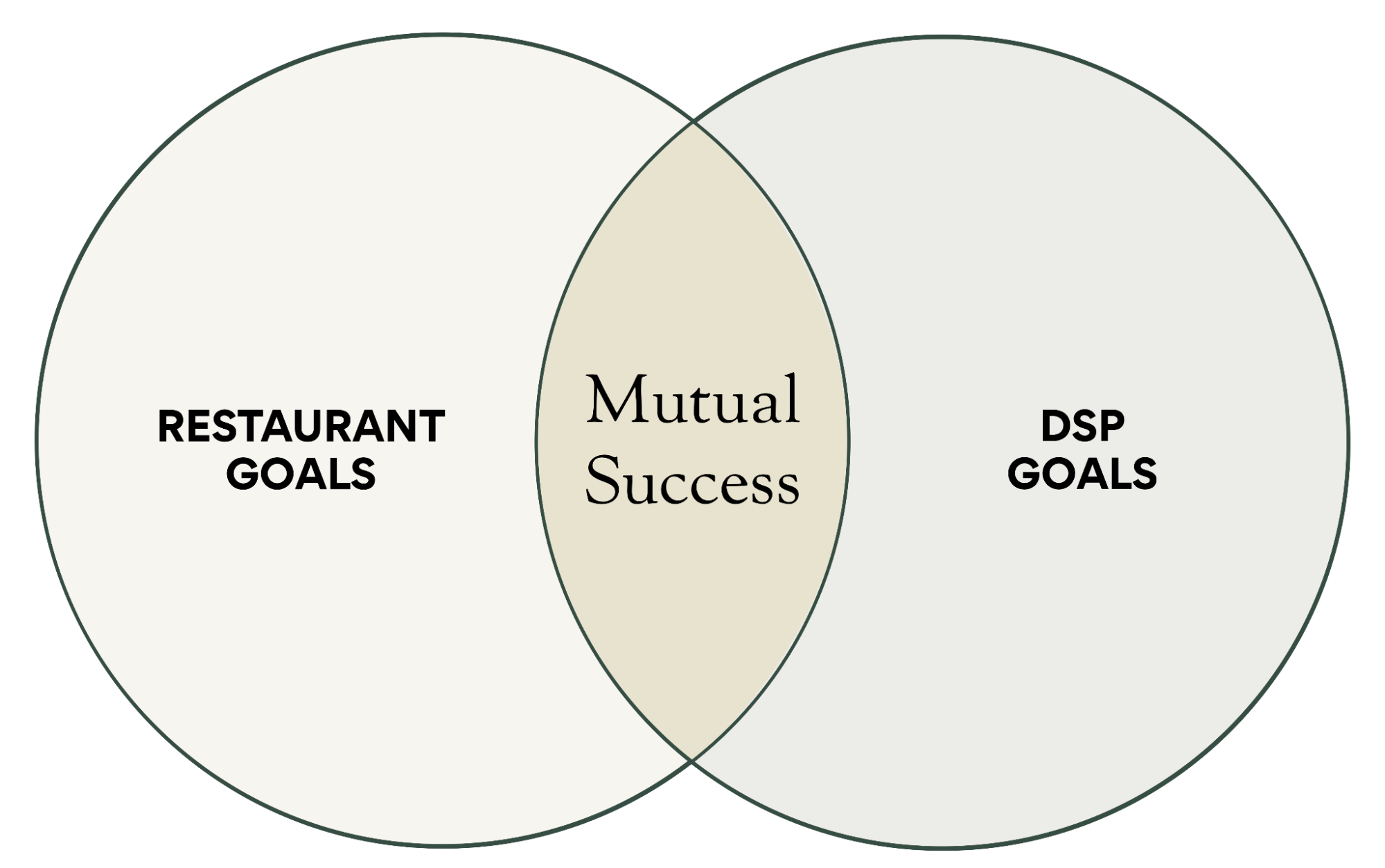
Any collaboration between partners requires both parties to have clarity on two things: their own objectives and the other party’s priorities. The fact is, DSPs need restaurants on their platform in order to have a marketplace, and restaurants, as we explored in Part 3, have come to depend on the revenue from DSPs. There is a whole lot of mutual interest in that equation.
Three articles into this DSP series, you know the history. As DSPs have evolved and become a vital part of restaurant revenue, restaurant leaders are starting to focus on the complexity of DSP contracts and the importance of their partnerships.
This final chapter is a practical framework for building a DSP partnership that holds up over time and actually serves your digital strategy.
Come Prepared
The key to a successful DSP contract negotiation is to find the point or points where those mutual interests intersect and build terms around them.
We’ve learned that you can’t approach your partnership with DSPs until you have a solid understanding of your vision for your broader digital business model. Being prepared for a DSP contract negotiation must start with a clear definition of your digital strategy, incorporating all aspects of the ecosystem – marketing, financial planning, operations, technology tools, people, and processes.
Once you have an established foundation in the form of a digital strategy, the DSP’s role in that strategy can be established. This includes assessing such variables as the percentage of your revenue coming from the DSP, the total cost of the service, the value of the platform as a guest acquisition tool, and the approach to paid advertising on the platform as a part of your overall marketing strategy.
Before you sit down at the table, you need to know exactly what you're sitting on. Start with your current contract: your true blended commission rate across marketplace and subscription tiers, the term and termination language, and what marketing commitments are on paper versus what's actually being spent.
That blended rate deserves particular attention. With subscription members now making up a larger share of transactions on most platforms, your effective rate is probably tracking much closer to the higher subscription tier than the marketplace rate you may be quoting internally.
Beyond the contract itself, gather the data that tells you how the relationship is actually performing: peer rate benchmarks, the incrementality and profitability of your historical sponsored listings (SLs) and promotions, your guest satisfaction scores, and your brand's performance metrics on the platform. Then build the financial models. You want scenarios mapped to different negotiation outcomes before you walk in, not after.
Don’t just rely on the DSP to bring you the data and take their word for it. Do your homework and come to the conversation with insights and data that you yourself have validated.
Once you have equipped yourself with the knowledge, data, insights, and expertise to approach the negotiating table, the next step is to determine the levers you want to employ to frame out a set of terms that meet your strategic goals.
First-Party Delivery (1PD) and Its Power
1PD is one of the strongest negotiation levers a multi-unit brand holds.
Orders placed through a brand's own app or website, fulfilled by DSP logistics, represents meaningful revenue to the DSP. Competition between the DSPs as 1PD logistics solutions can potentially open the door to deal structures such as…
- Exclusivity arrangements, where the brand commits its 1PD fulfillment to a single DSP in exchange for reduced marketplace commission rates
- Right-of-first-refusal agreements, where the DSP earns the opportunity to match before volume goes elsewhere
The DSP gets guaranteed revenue. The brand converts that into leverage across the entire relationship - lower commission rates, better terms, reduced total cost of the service.
In addition to the 1PD incentive, brands do have another carrot they can dangle – marketing spend.
Paying Closer Attention to Marketing Spend
Brands may have the opportunity to trade marketing commitments for lower commission rates. To employ that strategy effectively, it is important to consider all of the options for that marketing investment.
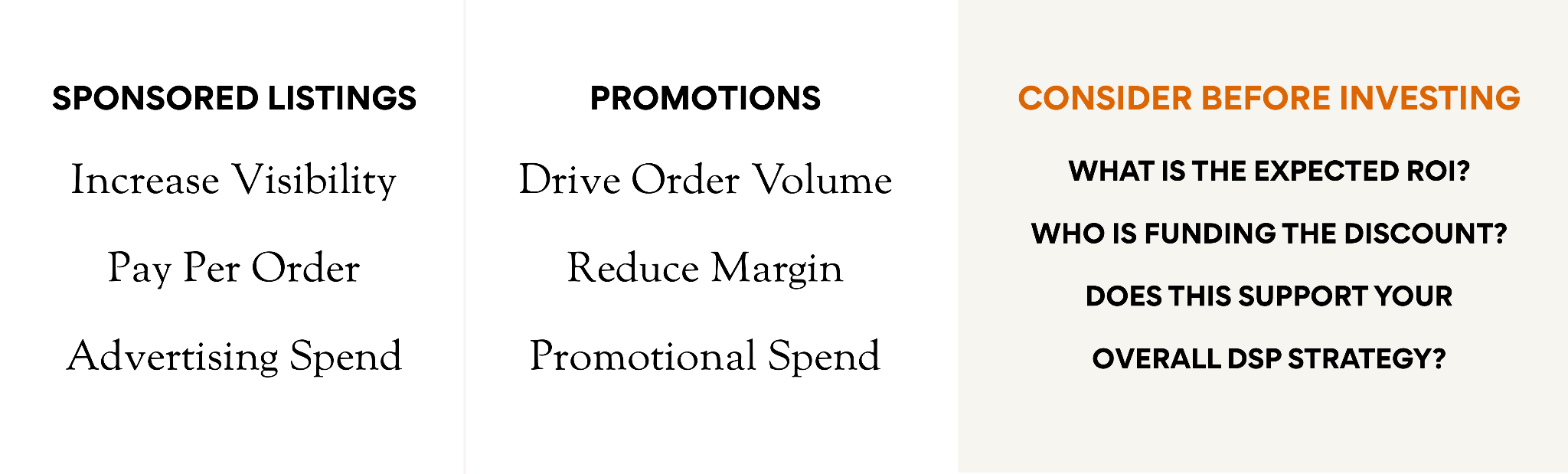
Sponsored listings and promotional discounts are often lumped together as "DSP marketing spend," but they work differently and create different cost models for each brand.
- Sponsored listings (SLs) are paid advertising where you bid for placement, and pay per order driven. They're a visibility tool.
- Promotional discounts, such as percentage-off offers, free delivery, and buy-one-get-one offers (BOGOs), are funded discounts on orders which reduce your realized revenue. You're not buying exposure necessarily, you're buying volume by offering value in exchange for margin reduction.
SLs and promos can be effective tools individually, and they can work together -- an SL driving traffic into a live promotion can move real volume. But stacking an SL expense on top of a discounted transaction can tip the whole thing into a per-order loss. Know your math before you commit to both.
The question of who funds the discount is where the DSP relationship can get complicated. DSPs will selectively co-fund promotions meaning they share some portion of the cost of the discount. How much and which type of co-funding the DSP will commit to is an important part of the contract discussion, and should be one that supports your paid marketing strategy.
As subscription programs have grown, platforms have increasingly approached brands to fund member-only pricing. Participating in those member-only pricing initiatives may or may not fit your brand’s objectives. Just keep in mind that your discount is supporting the DSPs own guest retention strategy. Before you opt in, run it as a guest acquisition cost. What are you paying per new guest, and how does that compare to your other acquisition channels? If the math holds, it's a reasonable trade. If it doesn't, you're subsidizing their retention program with your margin.
Be Proactive and Set the Agenda
The most important part of your DSP negotiation playbook is to be the driver. Many brands let their DSP rep set the agenda. Don't. You can establish a balanced approach to achieving the collaborative partnership we discussed earlier by setting the tone yourself.
Define your must-have terms, your nice-to-haves, and where you have genuine flexibility. Make it clear to your DSP representative that your expectation is for them to review your priorities ahead of any meeting and come prepared to meet your strategic objectives.
This includes drafting the actual agenda for DSP meetings. Set the agenda before the DSP does.
Conclusion
This concludes our four-part series on DSP partnerships and contracts. Thank you for following along.
The evolution of the DSPs as partners and the resulting complexity of the relationship today are vital strategic considerations for any restaurant brand.
A well-executed DSP negotiation requires scenario and financial modeling, contract insights, marketing strategy, and competitive market intelligence. And it's not a one-time event. Platform economics, rate, and terms shift regularly, and DSPs frequently introduce new programs designed to look like opportunities while quietly moving costs onto your plate. The brands that win are the ones who never stopped paying attention, not the ones that negotiated well once and left it at that.


Ready to move? Let’s talk.