Digital Transformation Starts with People

Digital hospitality has three legs: people, process, and technology. Each supports the others to make digital experiences feel as natural as in-store hospitality. Over the next three posts, we’ll explore how these elements work together – starting with the one that matters most: people.
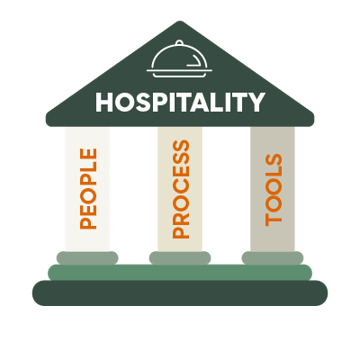
Every organization runs on people. Most brands already have team members updating menus, managing marketing promotions, or responding to guests – but few have defined how those digital roles and responsibilities roll up to a broader strategy for the holistic digital business model.
Many organizations end up working in silos rather than a cohesive vision. True transformation must first start with clarity: what is our vision, who owns what, how decisions move, and where accountability lives.
Structure Fuels Digital Growth
Digital transformation starts with people — and the structure that helps them work together.
A digital business model introduces new kinds of roles and responsibilities that don’t always fit neatly into a traditional restaurant org chart. The next step is aligning the right people around a shared digital vision that brings their work together.
As the 2025 Restaurant Growth Insights Report puts it, “Sustainable growth starts with strong operations. The old way of growing fast and fixing later doesn’t work anymore.” Leading brands are rethinking how people, technology, and visibility connect – putting systems and standards in place before they scale. The result: growth that’s repeatable, measurable, and profitable.
The work begins by recognizing that model and assessing how the current organization maps to it – clarifying ownership, accountability, and collaboration so every team moves in the same direction.
Define Ownership and Accountability
The core of every digital system is human.
There must be clear ownership of the digital business model: a single point of accountability bridging the traditional departments of IT, Marketing, Finance, and Ops. Someone must be able to see the whole picture – defining the vision, mapping the pathway to achieve it, ensuring accountability from all internal stakeholders, and connecting the dots across systems, data, and the guest journey.
But clarity can’t stop at defining roles — it’s about ensuring those roles exist across the right areas and work together toward shared digital outcomes. The organizational structure for a digital business model must intentionally span Marketing, IT, Operations, and Finance, so the people driving guest experience, system performance, and financial results are aligned around the same goals and metrics.
When those functions operate as one system instead of four silos, digital moves from a set of disconnected tasks to a coordinated business model. That’s when clarity becomes a competitive advantage.
Digital transformation starts with people, and succeeds with a unified vision.
The Bridge Between Vision and Execution
The rise of the Chief Digital Officer (CDO) across the restaurant industry signals a major shift in how brands think about their business model. The best operators are realizing that “digital” isn’t a department — it’s a system that depends on clear ownership, shared accountability, and alignment across the organization.
While it may not be practical or in the business's best interest to hire a full-time CDO to lead that shift, what is important is a structure that serves the same purpose: creating a unified vision, establishing clear direction and milestones, and coordinating across teams to bring that vision to life. For some organizations, it can mean engaging a fractional CDO as an external partner or even establishing a Digital Steering Committee that connects leadership functions around a single roadmap.
Across the industry, digital leadership is taking many forms.Many multi-unit brands are introducing senior roles focused on this mandate — with titles like VP or Director of Digital and Loyalty, Technology Transformation, Innovation and Commercialization, or Product and Channel Innovation.
Others, like Zaxby’s, have created a formal CDO role to unify loyalty, e-commerce, and guest engagement under one leader. KFC U.S., Denny’s, Yum Brands, and CKE Restaurants have taken similar paths — each recognizing that digital success depends on cross-functional alignment, not just more technology.
Building the Right Structure for Digital Leadership
If a dedicated CDO is not the right solution, at Figure 8 we have identified a collaborative model for centralizing the vision and strategy for a digital business model.
For example, one model we designed for a multi-unit brand included a collaborative steering team, with clear areas of responsibility:
- Chief Executive Officer – Sets vision and ensures enterprise alignment
- Chief Business Officer – Owns digital guest experience, loyalty, and marketing innovation
- Chief Operating Officer – Ensures operational adoption and field integration
- Chief Financial Officer – Oversees digital investments, ROI, and performance metrics
- VP of IT – Aligns technology infrastructure and integrations
- Digital Program Director – Coordinates execution, manages vendors, and drives roadmap progress
Supporting structures like quarterly digital strategy syncs, embedded KPIs, and a shared accountability framework keep everyone connected to the same outcomes.
Digital transformation starts with structure. The right people, aligned around a clear digital vision, turn systems into strategy and strategy into results.


Ready to move? Let’s talk.