The Catering Series: Part 1
Revenue You Don’t Realize You’re Missing

An office manager is on a restaurant’s website and clicks on “Catering.” There’s a beautiful page – great photography, a list of what’s available, maybe a paragraph about how perfect it is for the next office lunch. Then an “Inquire Now” and a form. And that’s the moment they move on to the next website.
This happens because the office manager has fifteen other things to do that morning. They had found you, were ready to order, and wanted to be done in about four minutes. A form that kicks off a back-and-forth email thread isn't a minor inconvenience – it's the moment they move on to another restaurant.
Many brands don’t realize how often this happens. And every time it does, it’s not just an order. Corporate catering guests usually have a short list of go-to places. You had a real shot at being one of them.
But when the process gets in the way, they find somewhere that makes it easier.
What That Moment Actually Costs
That scenario is a user experience (UX) problem, and more importantly it is a revenue problem.
The average individual delivery order runs around $34. The average corporate catering check is $275-300 – 1389% higher than individual orders– and brands with a well-built first-party on-demand ordering experience regularly see average checks above $5001. The margins are better too. Where standard delivery orders tend to have tight margins, catering can deliver significantly higher profits because those orders are scheduled and predictable.
You know exactly what to buy, what to produce, and how many people to schedule.
Waste drops.
Margin improves.
When it comes to corporate catering – office lunches, team events, client meetings – the guest is not spending their own money. That changes the dynamic entirely. They’re less price-sensitive and more open to suggestions. A well-designed online ordering platform will provide suggested add-ons and upsells in ways an email thread from an inquiry form never can.
Thus the criticality of frictionless ordering experience: it captures the guest at the moment of intent, lets the platform do the selling, and turns one of your highest-margin revenue channels into something that consistently performs and upsells – freeing your team to focus on what they do best: maki great food.
Capture the guest at the moment of intent. Let your platform do the selling. And turn one of your highest-margin revenue channels into something that consistently performs and upsells.
The Shortcut That Looks Like a Solution
Most brands know they need a comprehensive catering solution, and they need one now. The easy answer many reach for is a third-party catering marketplace.
On the surface, the appeal is obvious. These platforms handle ordering, dispatch, delivery, and guest issues resolution and follow-up. They put your brand in front of corporate buyers who are already looking. For a brand without its own catering infrastructure, they remove an enormous amount of complexity – fast.
Third-party marketplaces are expensive and own the guest’s data, and in the catering arena, it’s even more expensive than in regular a la carte ordering.
Third-party marketplace commissions can run as high as 30%. Discoverability on these platforms is a pay-to-win equation, and the leverage to improve a brand’s search results sits entirely with the marketplace.
There’s also a factor that adds to the pain of the commission math. When your catering volume runs through a third-party marketplace, you don't own the guest data.
In addition to that,
- You can’t reach that office manager directly.
- You can’t move them to your own channel.
- You can’t market to them directly to become one of their go-to places/
Why? Because they aren’t really your guest. They’re the other platform’s.
Is a First Party Catering Reckoning Coming?
There are signs that the restaurant industry’s tolerance for the expense of third-party delivery platforms is waning.
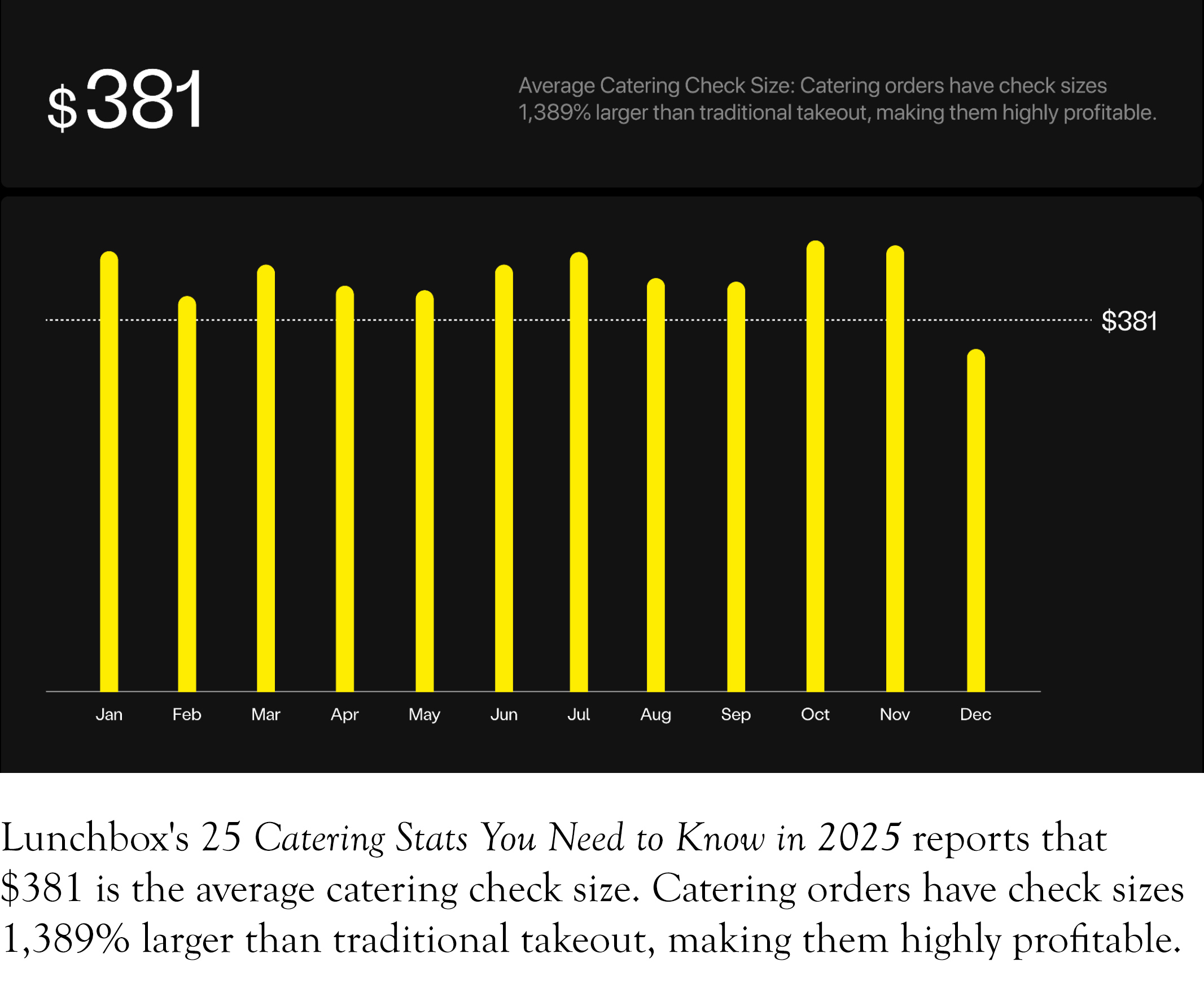
When a brand relies on a third-party marketplace for their on-demand catering, the revenue is significant and yet the margin impact is real. The US catering market is projected to hit $124 billion by 20322. Catering already accounts for 11% of total food service industry revenue3. The per-order math makes the stakes concrete. According to a 2025 report, the average catering check through a third-party marketplace runs around $3814.
Their data, corroborated by another 2025 report, shows first-party catering platforms produce average checks closer to $500 – and the brand keeps the full margin rather than surrendering 15-30% or more to the marketplace before a single dollar of additional marketing spend5.
With that level of profit on the line, brands are building first-party catering programs and thereby also owning the guest relationship at scale – rather than renting access to it from a marketplace that can change its rates, its algorithm, and its terms at any time.
Every catering order through a third-party marketplace builds their customer base, not yours.
Build It, Then Get the Word Out
The brands that win at catering follow a simple sequence: build a first-party program with a smooth and convenient guest experience, then market it.
A first-party catering channel only works if people know it exists. That means making catering extremely prominent on your website. It means proactively reaching the corporate buyers in your area, the people feeding twenty or more people every week, often several times per week. It means giving existing customers a reason to shift their catering business away from a marketplace and come directly to you. A well-timed incentive, a direct outreach, a clear landing page – the marketing can be simple with the objective of getting your program off the ground.
The first-party on-demand catering channel, done right, compounds. The person who has a great first experience becomes a repeat guest. The repeat guest tells someone else. The habit forms – this time with you.
The next post in this series breaks down exactly what that infrastructure looks like, where it most commonly breaks, and what to pressure-test before you launch.
Ready to move? Let’s talk.